Optimizers and Schedules: AdamW, Muon, WSD
Two choices decide how fast a model learns from the same data: how each gradient becomes an
update (the optimizer), and how big the steps are over time (the learning-rate schedule).
The repo has AdamW and Muon, and cosine, WSD and linear schedules, all written out in
src/optim/.
AdamW, briefly
AdamW keeps two running averages per number: the gradient m and the squared gradient v,
and steps along m / sqrt(v). Every weight gets its own step size. Weight decay is applied
directly to the weights ("decoupled"), not through the gradient:
The standard GPT recipe decays only the weight matrices, never biases or norm scales; that
split is adamw_param_groups().
Muon
AdamW treats a weight matrix as a bag of unrelated numbers. Muon
treats it as a matrix. It keeps an ordinary momentum M of the gradient, but instead of
stepping along M it steps along the closest orthogonal matrix: if M = U S V^T, the
update is U V^T, which has every singular value equal to 1. Every direction the gradient
points in gets the same step size, so useful but rare directions are not drowned out by the
few that dominate the gradient.
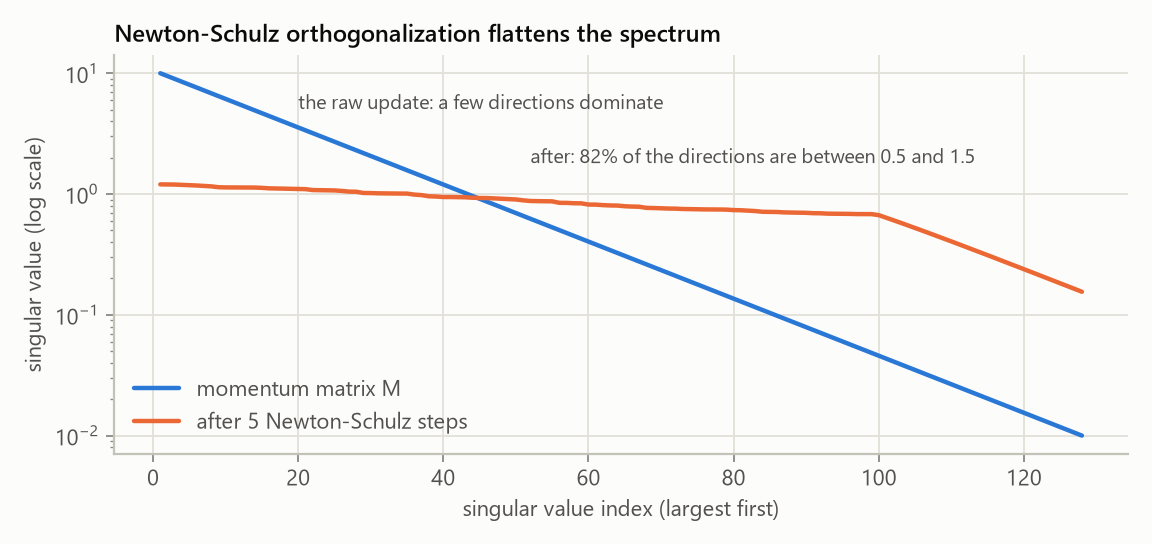
An SVD every step would be too slow, so Muon runs five iterations of a quintic Newton-Schulz map, a few matrix multiplications that push all singular values toward 1:
def newton_schulz(G, steps=5, eps=1e-7, coefficients=(3.4445, -4.7750, 2.0315), dtype=torch.bfloat16):
    a, b, c = coefficients
    X = G.to(dtype)
    transposed = G.size(0) > G.size(1)
    if transposed:
        X = X.T
    X = X / X.norm().clamp(min=eps)          # the Frobenius norm bounds the spectral norm
    for _ in range(steps):
        A = X @ X.T
        X = a * X + (b * A + c * (A @ A)) @ X
    return X.T if transposed else X
The coefficients are chosen to push small singular values up as fast as possible, at the cost of not converging exactly. In the plot, 82% of the directions end up between 0.5 and 1.5 instead of exactly 1, and the very smallest stay small after only five steps. Neither hurts training: what matters is that the few dominant directions no longer swamp the rest.
Muon only makes sense for the 2D hidden matrices. Embeddings, the output layer, norm scales
and biases keep using AdamW; muon_param_groups() makes that split, and our Muon class runs
both kinds of groups so it drops into any training loop.
How big should a Muon step be? Moonshot's scaling study
rescales each update to the typical size of an AdamW update (0.2 * sqrt(max(rows, cols))),
so the same learning rate and weight decay work for both parameter groups. That is the
default here (adjust_lr="match_rms_adamw"), so Muon reuses every learning-rate schedule
unchanged:
Muon set records in the nanoGPT speedrun and was scaled to a 1-trillion-parameter model
(Kimi K2). tests/test_optim.py checks our version against torch.optim.Muon (PyTorch 2.9+)
and the AdamW groups against torch.optim.AdamW.
Learning-rate schedules
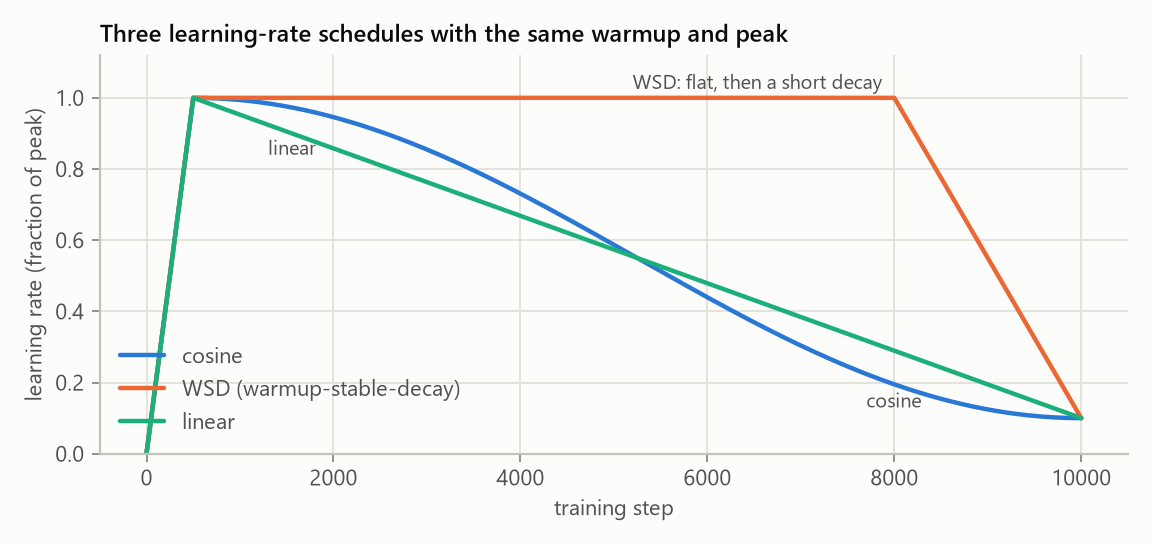
Every schedule starts with a linear warmup: at step 0 Adam's second-moment estimate is based on a single gradient, and a full-size step from it can damage a fresh model.
- Cosine (GPT-3, Llama 2): after warmup, follow half a cosine down to
min_lr. The schedule needs the total number of steps up front, and a checkpoint from the middle of the run is not "finished": its learning rate is still high. - WSD, warmup-stable-decay (MiniCPM, DeepSeek, OLMo 2): stay at the peak rate for most of training, then decay quickly over the last 10 to 20%. The practical win: you can take any checkpoint from the stable phase, run the short decay, and get a finished model, so the training length does not have to be fixed in advance. The loss drops sharply during the decay, which is normal.
- Linear to zero: a straight line from the peak down to
min_lr. Bergsma et al., 2025 found that decaying linearly all the way to zero matches or beats cosine at LLM scale.
python scripts/pretrain_base.py --lr_schedule wsd
python scripts/pretrain_base.py --lr_schedule linear --min_lr 0
The original train_transformer.py uses a step decay (one 10x drop at t_lr_decay_step,
80% of the way through in the presets), which is WSD with an instant decay.