Type Safety: Configs, Tensor Shapes and mypy
Most bugs in training code do not crash. A typo in a config key keeps the default value, a tensor with an extra dimension broadcasts into a bigger one, and the run finishes with a slightly wrong number that nobody notices. The repo catches these early at three levels: typed configs at startup, tensor shapes in the tests, and static types in CI.
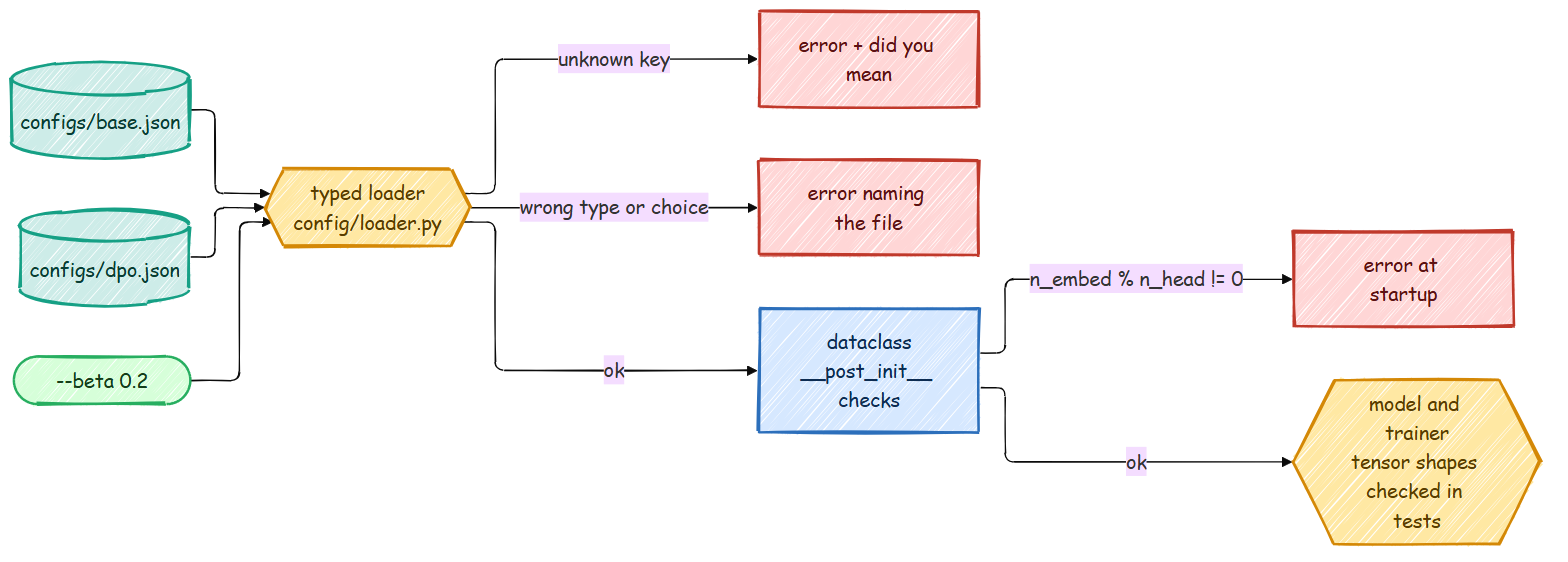
1. Typed configs, checked at startup
Every stage config is a dataclass in config/post_training_config.py. Fields have real types,
and fields with a fixed set of values use Literal:
PreferenceLoss = Literal["dpo", "ipo", "simpo", "orpo", "kto"]

@dataclass
class DPOConfig(BaseModelConfig):
    loss_type: PreferenceLoss = "dpo"   # dpo | ipo | simpo | orpo | kto
    beta: float = 0.1
    label_smoothing: float = 0.0        # > 0 = conservative DPO for noisy preference labels
    ...
    def __post_init__(self) -> None:
        super().__post_init__()
        _check(self.beta > 0, "beta must be positive")
        _check(0.0 <= self.label_smoothing < 0.5, "label_smoothing must be in [0, 0.5)")
config/loader.py merges configs/base.json, the stage JSON and the command line, and checks
every value against these types. The command-line flags are generated from the same
dataclass, so they can never drift apart. Real messages:
$ python scripts/train_dpo.py --config my.json          # my.json: {"betta": 0.1}
train_dpo.py: error: my.json: unknown key 'betta' for DPOConfig (did you mean 'beta'?)

$ python scripts/train_dpo.py --config my.json          # my.json: {"loss_type": "dop"}
train_dpo.py: error: my.json: loss_type must be one of ['dpo', 'ipo', 'simpo', 'orpo', 'kto'], got 'dop'

$ python scripts/train_dpo.py --config my.json          # my.json: {"beta": "high"}
train_dpo.py: error: my.json: beta must be a number, got 'high'

$ python scripts/pretrain_base.py --n_embed 100 --n_head 3
pretrain_base.py: error: n_embed (100) must be divisible by n_head (3) (from command line, configs/base.json, configs/pretrain.json)
Before this update, the first one printed a one-line notice and trained with the default
beta anyway, whatever the file said. Keys starting with _ are ignored, so you can still leave notes in a JSON file
("_comment": "..."), and --print-config shows the final, merged values without training.
The modern model has its own frozen dataclass, ModernConfig, which rejects impossible
shapes when it is built (for example n_head not divisible by n_kv_head, or an odd head
size, which RoPE cannot rotate).
2. Tensor shapes, checked in the tests
The newer modules annotate tensors with jaxtyping, which puts the shape in the type:
from jaxtyping import Float, Int
from torch import Tensor

def dpo_loss(
    policy_chosen_logps: Float[Tensor, "batch"],
    policy_rejected_logps: Float[Tensor, "batch"],
    ref_chosen_logps: Float[Tensor, "batch"],
    ref_rejected_logps: Float[Tensor, "batch"],
    beta: float = 0.1,
    label_smoothing: float = 0.0,
) -> LossAndRewards: ...

def forward(self, idx: Int[Tensor, "batch seq"], targets: Int[Tensor, "batch seq"] | None = None
            ) -> tuple[Float[Tensor, "batch seq vocab"], Float[Tensor, ""] | None]: ...
Every name is a dimension, and the same name must have the same size everywhere in one call:
all four inputs of dpo_loss must have the same batch. In a normal run these annotations
cost nothing, they are just documentation that cannot go stale. During the tests,
tests/conftest.py installs jaxtyping's import hook with beartype,
which checks every call into the annotated modules.
Here is the kind of bug it catches. Pass a (4, 1) tensor where a (4,) one belongs:
Without the check, PyTorch broadcasts the (4,) and (4, 1) tensors into a (4, 4) matrix,
averages 16 numbers instead of 4, and returns a perfectly plausible loss (0.67 in this case).
With the check:
TypeCheckError: Type-check error whilst checking the parameters of src.post_training.dpo.dpo_loss.
The problem arose whilst typechecking parameter 'ref_rejected_logps'.
Actual value: f32[4,1](torch)
Expected type: <class 'Float[Tensor, 'batch']'>.
The checked modules are listed in tests/conftest.py: the modern model, LoRA, the optimizers,
the inference code, and the DPO and GRPO losses. Run the tests without the checks (to time
them, for example) with SHAPE_CHECKS=0 pytest.
3. Static types in CI
mypy reads the annotations without running anything. CI runs it on
src/, config/ and data_loader/, and the modules added in this update are held to a
stricter standard: every function must be fully annotated (disallow_untyped_defs in
pyproject.toml). The packages ship a py.typed marker, so projects that import them get
the types too.
Some places where the static types earn their keep:
src/models/factory.pyreturnsLanguageModel = Transformer | ModernTransformer, so code that works with either model is checked against both.src/tokenizer/__init__.pydescribes what a tokenizer must provide as aProtocol, and bothtiktoken.Encodingand the BPE tokenizer satisfy it without inheriting from anything.- Config fields typed as
Literal[...], with mypy'sstrict_equalityon, make a misspelledcfg.loss_type == "simpo "a type error instead of a branch that is never taken.
Running the checks
uv sync                 # installs the dev group: pytest, beartype, ruff, mypy
uv run ruff check .     # style and common bugs
uv run mypy             # static types
uv run pytest           # tests, with runtime shape checks
uv run pytest -m "not slow"   # skip the end-to-end pipeline test (a few minutes on a CPU)
pre-commit install runs ruff on every commit. When you add code, annotate the tensors in its
signatures; if the module is new, add it to CHECKED_MODULES in tests/conftest.py and to the
strict list in pyproject.toml.