Stage 6: GRPO / RLVR (the reasoning frontier)
GRPO (Group Relative Policy Optimization) is the algorithm behind DeepSeek-R1, and it's beautifully simple: throw away PPO's value network. For each prompt, sample a whole group of answers, score them with a verifiable reward, and use the group's own mean/std as the baseline. The advantage is just "how much better than your groupmates was this answer?" No critic to train, no value loss.
For the group-relative advantage formula and how it relates to PPO-style policy ratios, see Objectives, Losses & Perplexity.
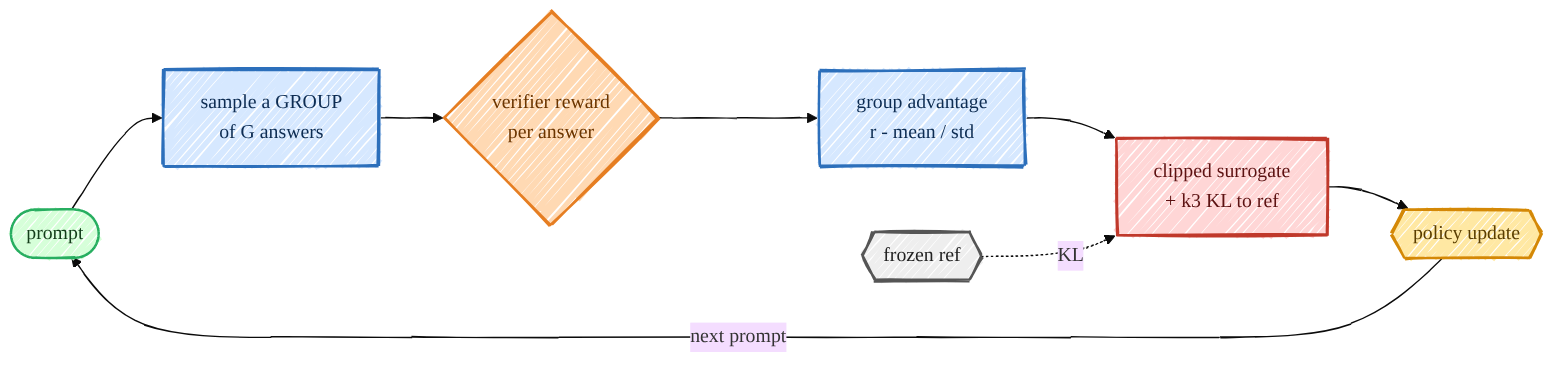
Mermaid source (live, editable)
flowchart LR
    PR([prompt]):::data --> G[sample a GROUP<br/>of G answers]:::proc
    G --> V{verifier reward<br/>per answer}:::rl
    V --> A[group advantage<br/>r - mean / std]:::proc
    A --> L[clipped surrogate<br/>+ k3 KL to ref]:::loss
    L --> UPD{{policy update}}:::model
    UPD -->|next prompt| PR
    REF{{frozen ref}}:::ckpt
    REF -. KL .-> L
    classDef data fill:#d6ffd9,stroke:#27ae60,stroke-width:2px,color:#143d1a;
    classDef proc fill:#d6e8ff,stroke:#2c6fbb,stroke-width:2px,color:#0d2c52;
    classDef rl fill:#ffd9b3,stroke:#e67e22,stroke-width:2px,color:#6b3500;
    classDef loss fill:#ffd6d6,stroke:#c0392b,stroke-width:2px,color:#5c1212;
    classDef model fill:#ffe8a3,stroke:#d48806,stroke-width:2px,color:#5a3d00;
    classDef ckpt fill:#eeeeee,stroke:#555,stroke-width:2px,color:#222;
Group-relative advantage
group_advantages is the whole idea: standardize rewards within
each group, so a good answer is one that beats its siblings on the same prompt:
def group_advantages(rewards, group_size, eps=1e-4):
    r = rewards.view(-1, group_size)             # rewards laid out group-contiguously
    adv = (r - r.mean(1, keepdim=True)) / (r.std(1, keepdim=True) + eps)
    return adv.reshape(-1)
A nice property: if every answer in a group gets the same reward (all right or all wrong), the std-based advantage is ~0 and that group simply contributes no gradient, so I log the fraction of informative groups as a health metric.
The loss: clipped surrogate + KL
grpo_loss applies the same PPO-style token-level clipped surrogate
(advantage broadcast across a completion's tokens) plus a per-token KL penalty to the reference, using
Schulman's non-negative k3 estimator (k3_kl):
ratio = torch.exp(new_logp - old_logp)
surrogate = torch.min(ratio * adv, torch.clamp(ratio, 1 - clip, 1 + clip) * adv)
kl = k3_kl(new_logp, ref_logp)                  # exp(Δ) - Δ - 1, always ≥ 0
loss = -masked_mean(surrogate - kl_coef * kl, resp_mask)
The trainer + curriculum
train_grpo.py loads the policy from sft.pt, replicates each prompt G
times (group-contiguously), rolls them out, scores with the GSM8K verifier, and updates. It runs an
arithmetic curriculum for the first --curriculum_iters iterations so the policy earns some reward
before facing full GSM8K (otherwise every group is all-wrong and there's no signal):
rows = next(warm_it if it < cfg.curriculum_iters else main_it)
prompts = [p for p in base_prompts for _ in range(G)]            # group-contiguous
rewards = torch.tensor([reward_gsm8k(responses[i], golds[i]) for i in range(len(prompts))])
adv = group_advantages(rewards, G)
The 2025 follow-ups to GRPO (Dr. GRPO, DAPO's clip-higher and dynamic sampling, GSPO's sequence-level ratio) are flags on this same trainer; see RL for reasoning.
Run it
python scripts/train_grpo.py --group_size 8
torchrun --standalone --nproc_per_node=2 scripts/train_grpo.py
# tune: --curriculum_iters 100 --kl_coef 0.04 --temperature 1.0
What the numbers mean
- reward: mean verifier reward across the group samples; the curve you want climbing.
- informative: fraction of groups with non-zero reward spread (groups that actually teach something). If this collapses to 0, raise temperature / group size or stay longer on the curriculum.
- KL: KL to the reference; keep it bounded.
- GSM8K test accuracy: the headline reasoning metric, evaluated every
--eval_every.
I verified the GRPO path genuinely optimizes: with a learnable reward the mean reward climbed 0.10 → 0.69 → 1.00 in ~15 iterations and saturated. PPO and GRPO share the same rollout/log-prob core, so this also exercises the common machinery.
Saved to models/grpo.pt.
➡️ Next: measure all stages on GSM8K and chat with the result.