Stage 5: PPO (classic RLHF)
This is the original ChatGPT recipe: let the model generate, score the generations with a reward, and nudge the policy toward higher-reward behaviour using Proximal Policy Optimization, with a value network (critic) for variance reduction and a KL penalty to keep it from drifting too far from the SFT model. I wrote the whole loop from scratch: rollout → reward → GAE advantages → clipped update.
The clipped objective and policy-ratio notation are introduced in Objectives, Losses & Perplexity. The optimizer and stability pieces are covered in Optimization & Training Systems.
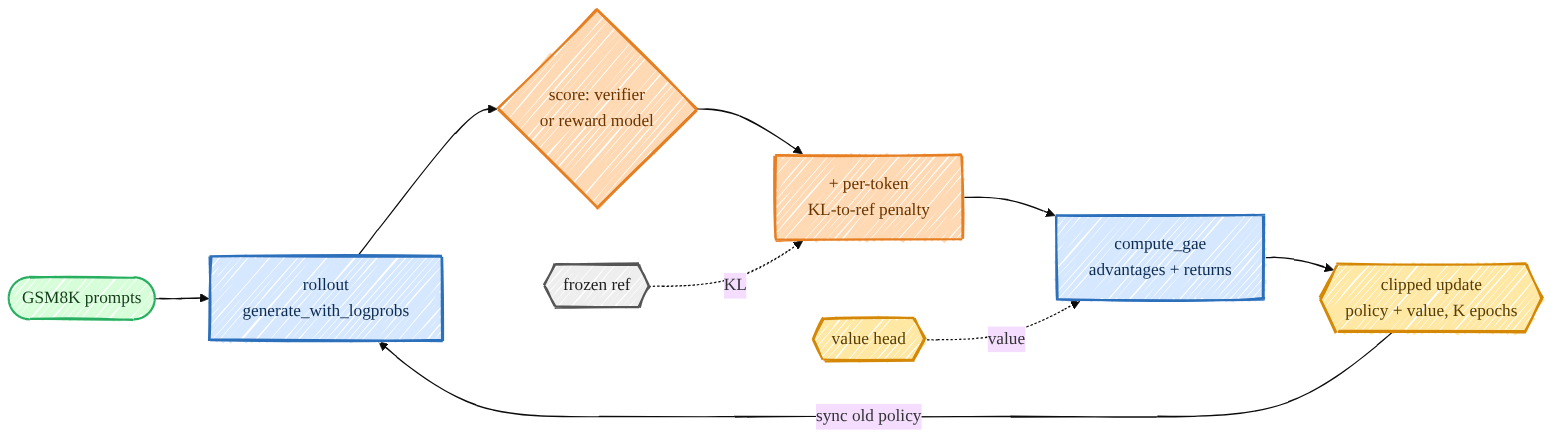
Mermaid source (live, editable)
flowchart LR
    PR([GSM8K prompts]):::data --> RO[rollout<br/>generate_with_logprobs]:::proc
    RO --> SC{score: verifier<br/>or reward model}:::rl
    SC --> KL[+ per-token<br/>KL-to-ref penalty]:::rl
    KL --> GAE[compute_gae<br/>advantages + returns]:::proc
    GAE --> UP{{clipped update<br/>policy + value, K epochs}}:::model
    UP -->|sync old policy| RO
    REF{{frozen ref}}:::ckpt
    REF -. KL .-> KL
    VH{{value head}}:::model
    VH -. value .-> GAE
    classDef data fill:#d6ffd9,stroke:#27ae60,stroke-width:2px,color:#143d1a;
    classDef proc fill:#d6e8ff,stroke:#2c6fbb,stroke-width:2px,color:#0d2c52;
    classDef rl fill:#ffd9b3,stroke:#e67e22,stroke-width:2px,color:#6b3500;
    classDef model fill:#ffe8a3,stroke:#d48806,stroke-width:2px,color:#5a3d00;
    classDef ckpt fill:#eeeeee,stroke:#555,stroke-width:2px,color:#222;
The actor-critic
PPO needs a per-token value estimate V(s_t) next to the policy logits. I get both from one backbone
with TransformerWithValueHead. It reuses
forward_hidden + lm_head for the policy and adds a small scalar value head (initialized to ~0 so the
critic doesn't destabilize early training):
def forward(self, idx):
    hidden = self.transformer.forward_hidden(idx)
    logits = self.transformer.lm_head(hidden)      # policy
    values = self.value_head(hidden).squeeze(-1)   # critic, (B, T)
    return logits, values
Rollout + log-probs
rollout_prompts length-buckets the prompts and samples a
completion for each, and generate_with_logprobs records the
sampling log-probs. Log-probs are always taken in fp32 (compute_logprobs)
because PPO subtracts them and bf16 rounding there is harmful.
GAE: Generalized Advantage Estimation
compute_gae works in the "action frame" (index t = producing
token t+1), bootstrapping only while the next action is still a response token:
for t in reversed(range(L)):
    nonterminal = m[:, t + 1] if t + 1 < L else 0.0      # episode ends after the last response token
    delta = rewards[:, t] + gamma * values_next[:, t] * nonterminal - values[:, t]
    lastgae = delta + gamma * lam * nonterminal * lastgae
    adv[:, t] = lastgae
returns = adv + values
The per-token reward is the KL-to-reference penalty at every response token, plus the scalar task
reward added at the last response token. Advantages are then normalized with
whiten.
The clipped objective
ppo_policy_loss is the standard clipped surrogate;
ppo_value_loss clips the value update too:
ratio = torch.exp(new_logp - old_logp)
surr1 = ratio * advantages
surr2 = torch.clamp(ratio, 1.0 - clip, 1.0 + clip) * advantages
loss  = -masked_mean(torch.min(surr1, surr2), mask)
train_ppo.py ties it together: rollout once, compute old log-probs / ref
log-probs / values, build rewards, GAE, then run ppo_epochs of minibatched clipped updates.
Run it
python scripts/train_ppo.py --reward_source verifier   # GSM8K checker as reward
python scripts/train_ppo.py --reward_source rm         # use the trained reward.pt
torchrun --standalone --nproc_per_node=2 scripts/train_ppo.py
What the numbers mean
- reward: mean task reward per iteration; the headline curve, should trend up.
- KL_ref: mean KL of the policy from the SFT reference; must stay bounded. If it blows up the
model is degenerating: lower the LR or raise
--kl_coef. - clipfrac: fraction of tokens hitting the PPO clip; a health and step-size signal.
- value_loss: critic regression error.
- GSM8K test accuracy: the real outcome, evaluated every
--eval_every.
PPO is the touchy one: small LR (
1e-6),clip 0.2, grad-clip 1.0, and watch KL. I verified the loop truly optimizes by giving it a learnable synthetic reward: reward climbed0.10 → 1.00.
Saved to models/ppo.pt.
➡️ Next: Stage 6: GRPO, which drops the critic entirely.