Stage 4: DPO (and ORPO / KTO)
Direct Preference Optimization is the shortcut around RLHF: instead of training a reward model and then
running an RL loop, DPO optimizes the policy directly on preference pairs, using a frozen copy of the
SFT model as a reference anchor. No reward model, no rollouts, no value function: just one clean loss.
I also implemented two popular variants behind a --loss_type flag: ORPO (reference-free) and
KTO (works from a desirable/undesirable signal). IPO, SimPO and conservative DPO are there too;
Preference optimization compares all of them.
For the sequence log-probability notation used here, see Objectives, Losses & Perplexity.
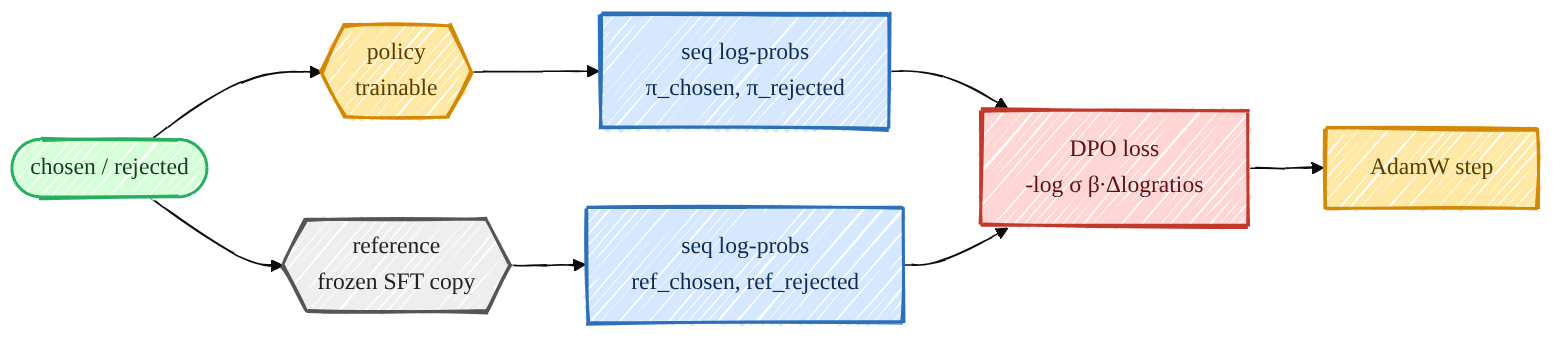
Mermaid source (live, editable)
flowchart LR
    P([chosen / rejected]):::data --> POL{{policy<br/>trainable}}:::model
    P --> REF{{reference<br/>frozen SFT copy}}:::ckpt
    POL --> LPP[seq log-probs<br/>π_chosen, π_rejected]:::proc
    REF --> LPR[seq log-probs<br/>ref_chosen, ref_rejected]:::proc
    LPP --> D[DPO loss<br/>-log σ β·Δlogratios]:::loss
    LPR --> D
    D --> UPD[AdamW step]:::model
    classDef data fill:#d6ffd9,stroke:#27ae60,stroke-width:2px,color:#143d1a;
    classDef proc fill:#d6e8ff,stroke:#2c6fbb,stroke-width:2px,color:#0d2c52;
    classDef model fill:#ffe8a3,stroke:#d48806,stroke-width:2px,color:#5a3d00;
    classDef ckpt fill:#eeeeee,stroke:#555,stroke-width:2px,color:#222;
    classDef loss fill:#ffd6d6,stroke:#c0392b,stroke-width:2px,color:#5c1212;
Sequence log-probs (the shared ingredient)
DPO compares how much more likely the policy makes the chosen response vs the rejected one, relative
to the reference. So I need the summed log-prob of each response under both models.
sequence_logprobs does exactly that (and is reused by PPO/GRPO):
def sequence_logprobs(model, sequences, response_mask, *, temperature=1.0, requires_grad=True):
    lp, mask = compute_logprobs(model, sequences, response_mask, temperature=temperature, requires_grad=requires_grad)
    m = mask.to(lp.dtype)
    return (lp * m).sum(dim=-1), m.sum(dim=-1)      # (summed logprob, #tokens) per sequence
The DPO loss
dpo_loss is the canonical objective. The β temperature controls how
hard it pushes away from the reference:
def dpo_loss(policy_chosen_logps, policy_rejected_logps, ref_chosen_logps, ref_rejected_logps, beta=0.1):
    pi_logratios  = policy_chosen_logps  - policy_rejected_logps
    ref_logratios = ref_chosen_logps     - ref_rejected_logps
    logits = pi_logratios - ref_logratios
    loss = -F.logsigmoid(beta * logits).mean()
    chosen_reward   = beta * (policy_chosen_logps   - ref_chosen_logps).detach()
    rejected_reward = beta * (policy_rejected_logps - ref_rejected_logps).detach()
    return loss, chosen_reward, rejected_reward
The two variants (orpo_loss,
kto_loss) live in the same file:
- ORPO: reference-free: combines the SFT negative-log-likelihood on the chosen response with an
odds-ratio preference term, folding SFT + alignment into one stage (no frozen reference needed).
- KTO: treats chosen as desirable and rejected as undesirable against a reference-KL baseline
estimated from the batch; useful when you only have thumbs-up/down rather than pairs.
The trainer
train_dpo.py loads the policy from sft.pt, makes a frozen reference with
make_frozen_copy (skipped for ORPO), and computes policy + reference
log-probs each step:
policy = load_backbone_from_ckpt(cfg, cfg.sft_ckpt, ctx.device)
ref = make_frozen_copy(policy, device=ctx.device) if cfg.loss_type != "orpo" else None
...
loss, cr, rr = _compute_losses(policy, ref, batch, cfg, ctx)   # picks dpo/orpo/kto by cfg.loss_type
loss.backward()
Run it
python scripts/train_dpo.py --loss_type dpo  --beta 0.1
python scripts/train_dpo.py --loss_type orpo --orpo_lambda 1.0
torchrun --standalone --nproc_per_node=2 scripts/train_dpo.py
DPO uses a small learning rate (
5e-7by default). It's easy to over-push away from the reference and degrade the model, so go gentle.
What the numbers mean
- loss: DPO/KTO start near
0.693; ORPO starts higher (it includes the NLL term). - acc: implicit-reward accuracy: fraction of pairs where the policy's implicit reward prefers the chosen response. Should climb above 0.5.
- r_chosen / r_rejected: the implicit rewards
β·(logπ − logref); the gap (margin) should widen. - GSM8K dev accuracy: the real downstream check.
Saved to models/dpo.pt.