Attention: GQA, MLA, QK-norm, Sliding Windows and the KV Cache
The classic model computes attention exactly as the paper writes it: one small module per
head, the (T x T) score matrix in memory, a stored triangular mask, an explicit softmax.
The modern model computes the same function, organized for memory: fewer key/value heads,
a cache for generation, and a fused kernel.
The KV cache, and why it dominates memory
When a model generates, the keys and values of earlier tokens never change (attention is causal), so there is no need to recompute them. A KV cache stores them; each new token only computes its own query, key and value, and attends to the stored ones. Generation goes from O(n^2) to O(n) work.

The price is memory. For every token, every layer stores one key and one value vector per key/value head:
For a Llama-3-8B-sized model (32 layers, 128-dimensional heads, bf16) with one key/value head per query head (32), that is 512 KB per token: a single 128K-token conversation needs 64 GB of cache, more than the model itself. This, not the weights, is what limits batch size and context length when serving an LLM. The rest of this page is about shrinking it.
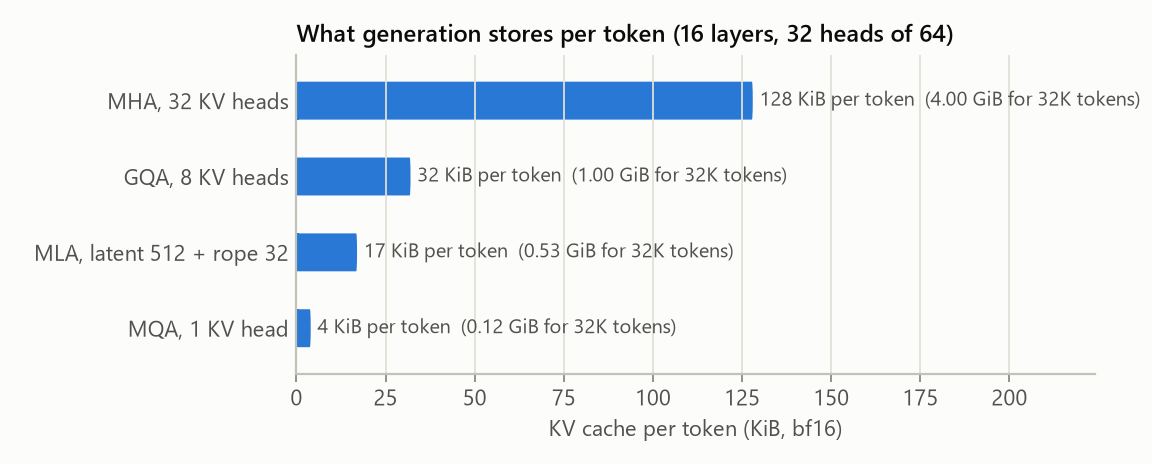
The plot is computed from the formula, for a 1B-parameter-class config (16 layers, 32 query heads of size 64, bf16).
Grouped-query attention
GQA lets several query heads share one key/value head.
With n_head = 32 and n_kv_head = 8, every group of 4 query heads reads the same keys and
values, and the cache is 4x smaller. n_kv_head = 1 is multi-query attention (MQA), the
extreme case; n_kv_head = n_head is ordinary multi-head attention.

k = self.k_proj(x).view(B, T, Hkv, D).transpose(1, 2)    # only Hkv key heads are computed and cached
v = self.v_proj(x).view(B, T, Hkv, D).transpose(1, 2)
...
if Hkv != H:                                             # each group of H // Hkv query heads
    k = k.repeat_interleave(H // Hkv, dim=1)             # reads the same key/value head
    v = v.repeat_interleave(H // Hkv, dim=1)
The quality cost is small (Llama 2 70B, Llama 3 and Qwen 3 all use GQA). One way to see that
nothing magic happens: test_gqa_equals_mha_with_shared_heads builds a GQA layer and an MHA
layer whose key/value weights are copies of the GQA groups, and checks they give the same
output.
Multi-head latent attention
DeepSeek-V2 went further. Instead of caching keys and values, cache one small latent vector per token, and rebuild every head's key and value from it with two linear maps:
There is a catch: a rotated key can no longer be rebuilt from the latent, because the rotation
depends on the position and the up-projection does not. MLA's fix is to split each head in
two: a "content" part that comes from the latent and carries no position, and a small
"position" part (rope_dim numbers) that carries RoPE, with one rotated key shared by all
heads. The cache holds the latent plus that one shared key:
| Attention | Numbers cached per token per layer | Example (32 heads of 128) |
|---|---|---|
| MHA | 2 * n_head * head_dim |
8192 |
| GQA, 8 KV heads | 2 * n_kv_head * head_dim |
2048 |
| MQA | 2 * head_dim |
256 |
| MLA (DeepSeek-V3: latent 512, rope 64) | latent + rope_dim |
576 |
MLA keeps the quality of full multi-head attention (every head still has its own keys and
values) at roughly the cache cost of MQA. Our MultiHeadLatentAttention keeps the
up-projections explicit so the idea stays visible; production code folds W_uk into the
query projection at inference time so the full keys are never materialized.
QK-norm and gated attention
Attention logits are dot products of queries and keys. If their norms drift up during
training, the softmax saturates (one key gets all the weight) and gradients vanish; this is
one of the classic causes of loss spikes in large runs. QK-norm applies RMSNorm to every
query and key head before the dot product, which bounds the logits. OLMo 2, Qwen 3 and
Gemma 3 use it. It is on by default here (qk_norm).
Gated attention (Qwen team, 2025, used in Qwen3-Next)
multiplies each head's output by a sigmoid gate computed from the input. A head can then
output "nothing" when it has nothing useful, instead of being forced to spread attention
somewhere (the "attention sink" effect). Turn it on with attn_gate: true.
Sliding-window attention
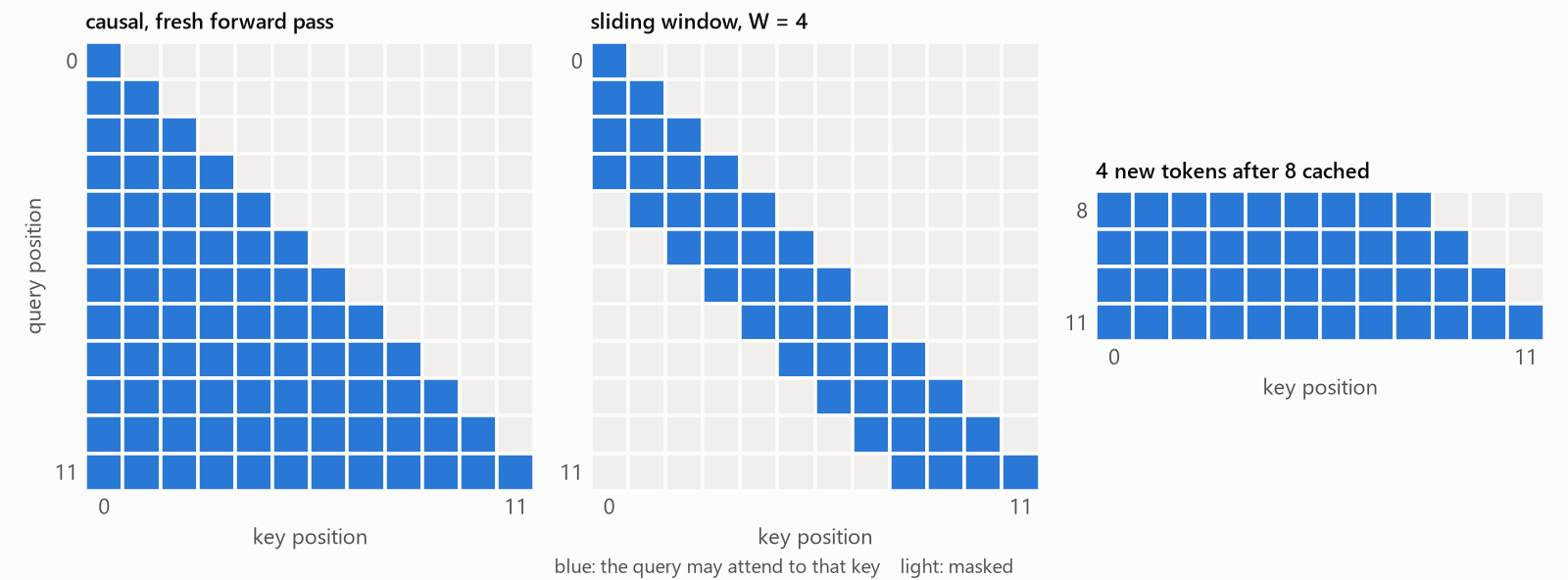
With a window W, token t attends only to tokens t - W + 1 .. t. The cost of attention
then grows with the window instead of the whole text, and the cache can drop tokens older
than the window. Information still travels further than W: with L layers, layer by layer,
the receptive field grows to about L * W tokens. Mistral 7B used it in every layer; Gemma 3
uses five windowed layers for every full-attention layer, and GPT-OSS alternates the two.
The mask with a cache: a subtle pitfall
F.scaled_dot_product_attention(..., is_causal=True) builds a triangular mask aligned to
the top-left corner: query i may see keys 0..i. That is right for a fresh forward
pass, where queries and keys are the same positions. With a cache, the queries are the last
T positions and the keys are all start + T positions, so query i is really at position
start + i and must see keys 0..start + i. The top-left mask would hide almost the whole
cache. attention_mask() builds the right mask from absolute positions:
q_pos = torch.arange(start, start + q_len)[:, None]       # where the queries really are
k_pos = torch.arange(k_len)[None, :]
allowed = k_pos <= q_pos                                   # causal
if window is not None:
    allowed &= k_pos > q_pos - window                      # sliding window
and skips the mask tensor in the two common cases: a fresh pass uses the fast
is_causal=True path, and a single new token with a cache may see every cached key.
test_kv_cache_matches_full_forward decodes token by token with the cache and checks the
logits against a full forward pass, for every attention variant.
FlashAttention for free
F.scaled_dot_product_attention picks the fastest available kernel. On recent NVIDIA GPUs
that is FlashAttention, which never stores the (T x T) score matrix: it streams blocks of
keys through fast on-chip memory and keeps a running softmax. Memory for attention becomes
linear in the sequence length. The classic model, which builds the full matrix in every
head, needs batch x heads x T x T floats per layer just for the scores.