Inference: Sampling, the KV Cache, Speculative Decoding and int8
Training ends with a checkpoint. This page is about turning it into text quickly and cheaply: how a token is picked, how the KV cache avoids repeated work, how a small model can speed up a big one without changing its output, and how to store the linear layers in a quarter of the memory. Everything here works from one script:
python scripts/generate_text.py --model_path models/student.pt                      # sampling
python scripts/generate_text.py --model_path models/student.pt --top_k 0 --min_p 0.05
python scripts/generate_text.py --model_path models/student.pt --draft_model models/tiny.pt
python scripts/generate_text.py --model_path models/student.pt --int8
Picking the next token
The model gives a score (logit) for every token in the vocabulary. Turning those scores into
one token is a choice, and src/inference/sampling.py applies the usual knobs in order:
| Knob | What it does | Typical value |
|---|---|---|
temperature |
divides the logits: below 1 sharpens the distribution, above 1 flattens it | 0.7 to 1.0 |
top_k |
keeps the k most likely tokens |
40 to 100 |
top_p |
keeps the most likely tokens until their probabilities add up to p |
0.9 to 0.95 |
min_p |
keeps tokens at least min_p times as likely as the top token |
0.05 to 0.1 |
| greedy | always takes the most likely token | for evaluation |
min-p sampling is the newest of these. Top-p keeps a fixed amount of probability mass, so when the model is unsure it can let in a long tail of bad tokens, and when it is sure it may still keep a few. Min-p scales its cutoff with the model's confidence:
if min_p is not None and 0.0 < min_p < 1.0:
    probs = logits.softmax(dim=-1)
    threshold = min_p * probs.max(dim=-1, keepdim=True).values
    logits = logits.masked_fill(probs < threshold, float("-inf"))
When the top token has probability 0.9, min-p 0.1 keeps only tokens above 0.09. When the top token has 0.05, it keeps everything above 0.005, which may be dozens of reasonable choices. Both models and both generation paths share this code. Generation & Sampling covers the basics.
Prefill and decode with the KV cache

The classic model's generate is the textbook loop: run the whole window through the model,
keep the last row of logits, sample, append, repeat. Every step recomputes the keys and values
of every earlier token, although they never change.
The modern model's generate uses the KV cache (src/models/modern/kv_cache.py) and works in
two phases:
- Prefill: one forward pass over the prompt fills the cache with every layer's keys and values.
- Decode: each new token runs through the model alone, attends to the cache, and appends its own key and value.
cache = self.new_cache(idx.size(0))
hidden = self.forward_hidden(idx[:, -window:], cache)        # prefill
for _ in range(max_new_tokens):
    logits = self.lm_head(hidden[:, -1, :])
    next_token = sample_next_token(logits, temperature, top_k, top_p, min_p)
    idx = torch.cat([idx, next_token], dim=1)
    if cache.length >= window:                                # out of room: keep the latest half
        cache.reset()
        hidden = self.forward_hidden(idx[:, -(window // 2):], cache)
    else:
        hidden = self.forward_hidden(next_token, cache)        # decode one token
When the cache is full, the model keeps the most recent half of the text and prefills it
again. Positions restart from 0, so they stay inside the range the model was trained on and
the rotary tables cover, at the price of one extra pass every window / 2 tokens.
test_kv_cache_matches_full_forward
and test_cached_and_uncached_generation_agree check that cached decoding gives the same
logits as recomputing everything.
How much this saves depends on the length. Without the cache, token n costs a forward pass
over n tokens; with it, a pass over one token plus attention to n cached ones. For a long
generation that is the difference between quadratic and linear total work. On a laptop CPU, a
student-sized model (2.6M parameters) generated 240 tokens at about 65 tokens per second
without the cache and 130 to 180 with it, with exactly the same output, and the gap grows with
the length of the text.
The PPO and GRPO rollouts, the GSM8K evaluation and chat.py all generate through
generate_with_logprobs (src/post_training/rollout.py), which uses the same cache when the
model is the modern one. That matters most for RL, where rollouts are most of the training
cost. With a student-sized model on a laptop CPU, 8 prompts of 32 tokens with 160 new
tokens each took 2.4 seconds with the cache and 13.5 without it.
Speculative decoding
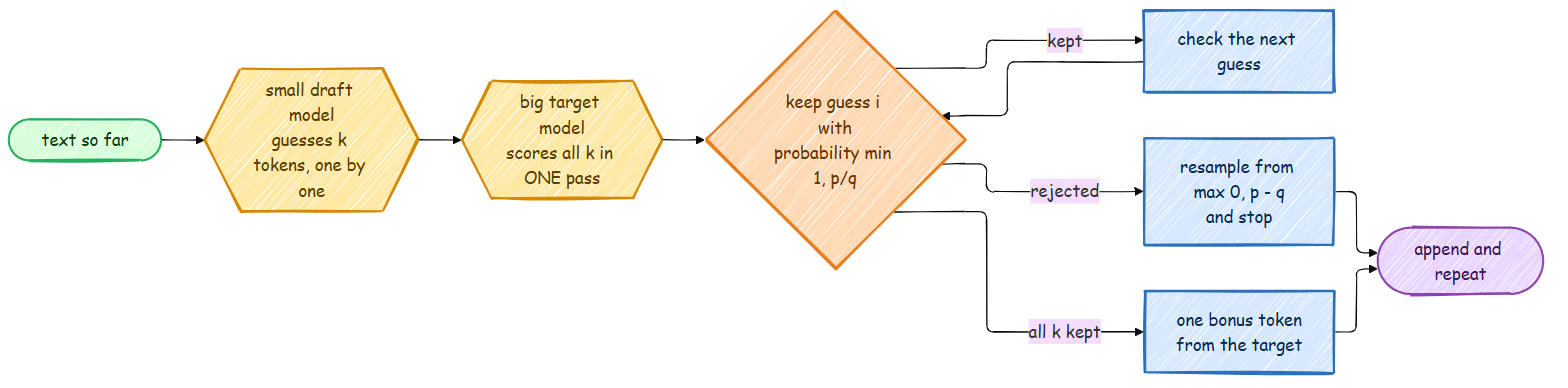
Generating with a big model is slow because each token needs a full forward pass and the
passes cannot overlap. But checking several tokens costs about the same as generating one: a
forward pass over k tokens reads the weights once, and on a GPU reading the weights is most
of the cost. Speculative decoding (Leviathan et al., 2023;
Chen et al., 2023) exploits that:
- A small draft model guesses the next
ktokens, one at a time (cheap). - The big target model scores all
kguesses in one forward pass. - Each guess
xis kept with probabilitymin(1, p(x) / q(x)), wherepis the target's probability andqthe draft's. At the first rejection, a replacement is sampled frommax(0, p - q), renormalized. If allkare kept, the target's last row gives one bonus token for free.
The surprising part is that the output follows the target's distribution exactly, however
bad the draft is. For one position, a token x comes out either because the draft proposed it
and it was kept, or because a rejection resampled it:
The first term is min(p(x), q(x)). In the second, 1 - sum min(p, q) equals
sum max(0, p - q) (both are the total amount by which p exceeds q), so the fraction
cancels and leaves max(0, p(x) - q(x)). The two add up to p(x). A good draft only changes
how many tokens each target pass produces. test_sampling_keeps_the_target_distribution_whatever_the_draft
checks this by sampling 3,000 times with a deliberately different draft. With greedy decoding
the rule becomes "keep a guess if it is the target's top token", so the output is identical to
plain greedy decoding with the target, which test_greedy_speculative_decoding_equals_greedy_target_decoding
checks.
from src.inference.speculative import speculative_generate

out, stats = speculative_generate(target, draft, prompt_ids, max_new_tokens=200, k=4, temperature=0.8)
print(stats.acceptance_rate, stats.tokens_per_target_call)
The draft must use the same tokenizer as the target. In the student track that comes for free:
the tiny and student presets share the BPE trained by prepare_tiny_data.py.
Measured with the two tiny models, which share a tokenizer: the classic one (636K parameters)
as the target and the modern one (369K) as the draft, on 10 prompts with 100 new tokens each
and k = 4:
| Decoding | Guesses kept | Tokens per target pass | Target passes for 1,000 tokens |
|---|---|---|---|
| greedy | 38% | 2.48 | 403 |
| sampling, temperature 0.8 | 35% | 2.35 | 426 |
The target ran 403 times instead of 1,000 for the same greedy text. The wall-clock time still
got worse, 7.5 seconds against 4.1: this "small" draft costs as much per token as the target,
because most of both models is the same 4096-row output layer, so 403 target passes plus 1,587
draft passes take longer than 1,000 target passes. Speculative decoding pays off when the draft
is far cheaper than the target (a 1B draft for a 70B target, say) and on GPUs, where checking
k tokens costs about the same as generating one. Try it with your own pair:
python scripts/generate_text.py --model_path models/student.pt --draft_model models/tiny.pt --draft_k 4
This implementation recomputes the prefix on each call instead of keeping a KV cache for both
models, to keep the algorithm in plain view. It counts target passes, which is what the
speedup comes from on a GPU, rather than racing the cached generate on wall-clock time.
int8 weights
A float32 weight takes 4 bytes; an int8 takes 1. Weight-only quantization
(src/inference/quantize.py) stores every nn.Linear weight as int8 plus one float scale per
output row:
class Int8Linear(nn.Module):
    def __init__(self, linear):
        w = linear.weight.detach().float()
        scale = w.abs().amax(dim=1, keepdim=True).clamp(min=1e-8) / 127.0     # one scale per output row
        self.register_buffer("weight_int8", torch.round(w / scale).clamp(-127, 127).to(torch.int8))
        self.register_buffer("scale", scale)

    def forward(self, x):
        return F.linear(x, (self.weight_int8.float() * self.scale).to(x.dtype), self.bias)
One scale per row ("per channel") matters: a single scale for the whole matrix would let one large weight squeeze every other row into a few integer levels. The matrix multiply still runs in floating point, so this saves memory, not arithmetic. That is the right trade for generation, where each token reads every weight once and memory bandwidth, not compute, sets the speed.
Measured on the trained tiny models, on 16 windows of held-out TinyStories text:
| Model | Checkpoint size | Logit cosine similarity | Same top token | Held-out loss |
|---|---|---|---|---|
| tiny classic | 2.55 MB to 2.26 MB | 0.99999 | 99.5% | 3.362 to 3.362 |
| tiny modern | 1.48 MB to 1.16 MB | 0.99998 | 99.0% | 2.818 to 2.818 |
The loss does not move in the third decimal. The size barely moves either, because in tiny
models most of the weights are the embedding table, which is a lookup and stays in float. At a
realistic size the linear layers dominate. For the ~400M-parameter configs/base.json model:
| Architecture | Parameters | Checkpoint size |
|---|---|---|
| classic | 406M | 1.51 GiB to 0.67 GiB (2.3x smaller) |
| modern | 355M | 1.32 GiB to 0.48 GiB (2.8x smaller) |
The output layer is left in float by default (skip=("lm_head",)): in the modern model it is
the same matrix as the input embedding, and quantizing it would quietly untie the two. The
classic model gains less because its untied output layer and position table stay in float.
int8 weight-only is the simplest member of a big family. Going further means 4-bit weights with groups of 32 to 128 values sharing a scale (GPTQ, AWQ), or quantizing activations too so the matrix multiply itself runs in int8 or fp8.