Mixture of Experts
A dense model runs every parameter for every token. A Mixture-of-Experts (MoE) layer holds many feed-forward blocks, the experts, and sends each token to only a few of them. The model can then have far more parameters (more knowledge) while each token costs about the same compute as a dense model. DeepSeek-V3 has 671B parameters but activates 37B per token; Mixtral, Qwen 3 MoE and GPT-OSS work the same way.
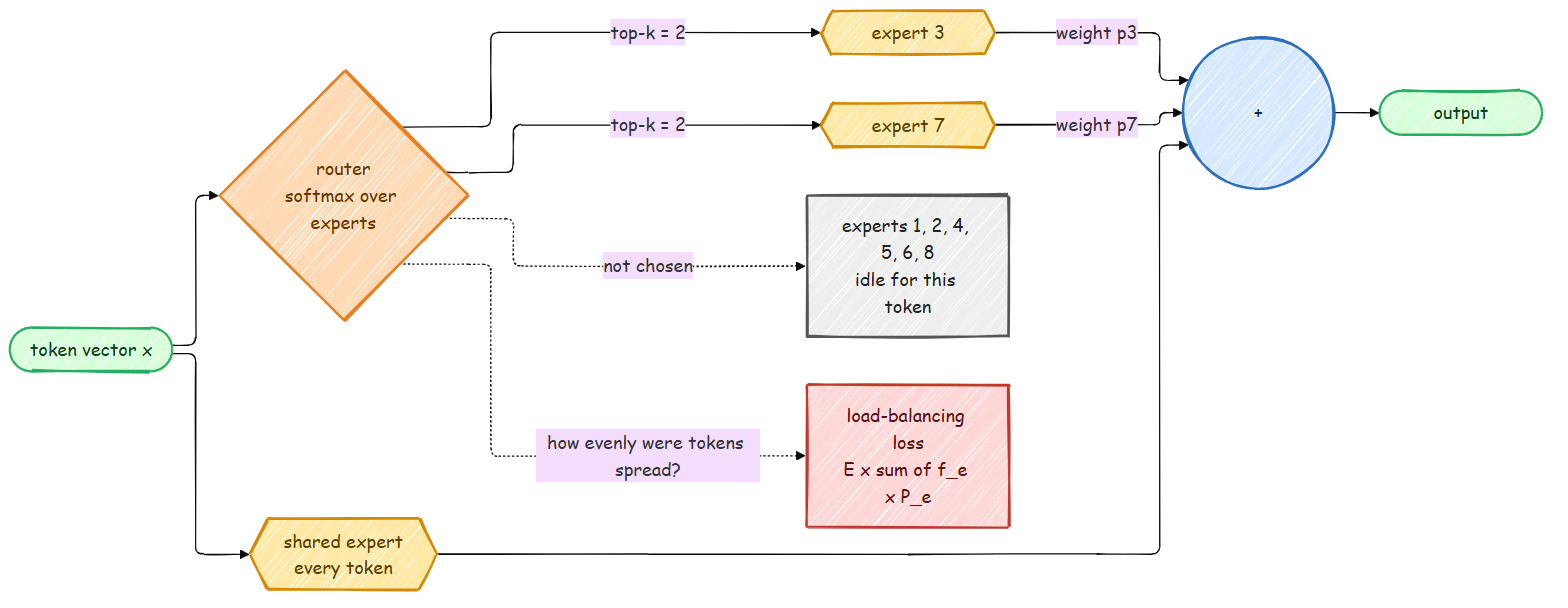
Routing
For each token x, a small linear router scores all E experts, and a softmax turns the
scores into probabilities. The token goes to its k most likely experts, and their outputs
are mixed with those probabilities, renormalized over the chosen ones:
probs = F.softmax(self.router(flat).float(), dim=-1)        # (tokens, experts)
weights, chosen = probs.topk(self.top_k, dim=-1)              # (tokens, k)
weights = weights / weights.sum(dim=-1, keepdim=True)

out = torch.zeros_like(flat)
for e, expert in enumerate(self.experts):
    token_idx, slot = torch.where(chosen == e)                # which tokens picked expert e
    if token_idx.numel():
        out.index_add_(0, token_idx, expert(flat[token_idx]) * weights[token_idx, slot, None])
The loop over experts is the clearest way to write it. Production code sorts tokens by expert and runs one grouped matrix multiply, and spreads experts over GPUs (expert parallelism), but the math is the same.
Keeping the experts busy: the balancing loss
If nothing pushes back, a few experts win early, get all the tokens, improve faster, and win even more; the other experts never learn. The Switch Transformer fix is an auxiliary loss that is smallest when routing is uniform:
f_e is the fraction of routing slots that went to expert e (counted, not differentiable)
and P_e is the average router probability for e (differentiable). With perfectly even
routing both are 1/E and the loss is 1; as routing piles onto a few experts it grows, up to
E / k. The model adds moe_aux_loss_coef * aux (0.01 by default) to the language-modeling
loss, averaged over the MoE layers. tests/test_modern_model.py checks that the gradient of
this loss reaches the router.
Pretraining and SFT add this loss (moe_balance_loss() in src/post_training/utils.py). The
preference and RL stages, which move the model much less, do not, like most fine-tuning
setups; watch tokens_per_expert if you run them for long on an MoE model.
DeepSeek-V3 replaced this loss with a per-expert bias that is nudged up or down after each step depending on the expert's load, which balances without pulling on the main objective. It is a nice extension exercise.
Shared experts
DeepSeekMoE adds one or more shared experts that every
token goes through. They hold the common knowledge every token needs, so the routed experts
are free to specialize. Set n_shared_experts: 1 to try it.
Parameters vs compute
ModernTransformer.num_params() counts everything; active_params() counts only what one
token uses (the shared parts plus k routed experts per layer):
from src.models.modern import ModernConfig, ModernTransformer
cfg = ModernConfig(n_embed=512, n_head=8, n_blocks=8, n_experts=8, moe_top_k=2)
model = ModernTransformer(cfg)
print(f"{model.num_params()/1e6:.0f}M total, {model.active_params()/1e6:.0f}M active per token")
# 173M total, 69M active per token
Training FLOPs follow the active count (flops_per_token() uses it). Memory follows the
total count: every expert must be stored, and with Adam each parameter costs about 16 bytes
during training. That is the MoE trade: more memory for the same compute.
Try it
With MoE, the router probabilities and expert loads are worth logging. MoE.tokens_per_expert
holds the counts from the last forward pass of each layer; a healthy run keeps them close to
tokens * k / E.